

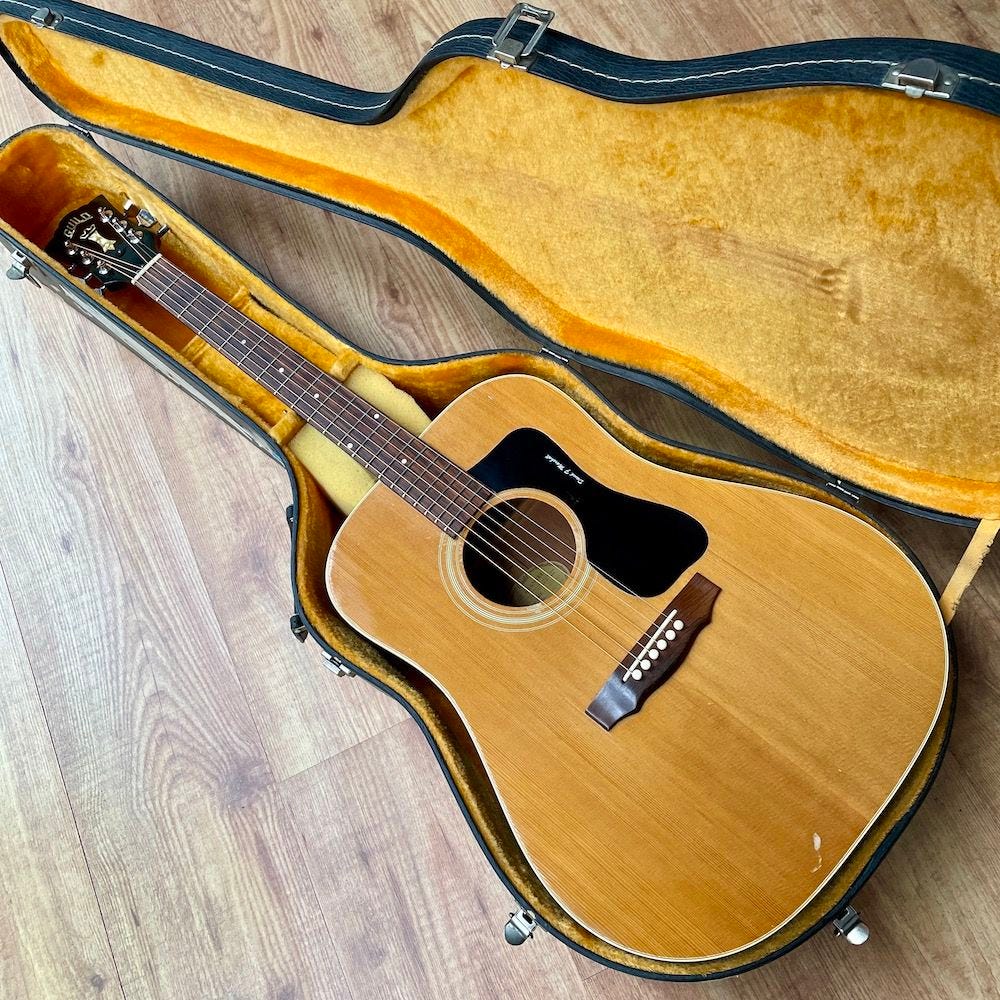
Every musician has one instrument that becomes part of their life’s weather. For me, it was this 1973 Guild D‑40 - I called her Eliza-Ellen. The story that follows is not about a guitar so much, as the life that gathered around her - and the quiet grace of letting her go.
The first time I played Eliza‑Ellen in public was in a field near Llangollen, North Wales. One of those half‑organised festivals where the stage is a pallet and the audience is a scatter of blankets. Someone in a Birkenhead accent shouted, “Play us a tune, la…” So I did. Three of them. Alternating bass, a bit of slide, and a Donovan pop tune I’d only just worked out. It was the first time I felt her open up in front of strangers, and something in me recognised the feeling, not as a beginning, but as the moment when a long, private hunger finally made itself heard.
I’d been chasing that sound for years without knowing it. At twelve I borrowed my first acoustic guitar, and two years later, in Valencia, I bought one of my own for around 450 pesetas. About £5 at the time, roughly ten weeks’ wages from my part‑time job. It wasn’t much of a guitar, but it didn’t need to be. Those two instruments, the one borrowed and the one bought, were the beginning of everything.
Those guitars carried me through my teens, and by my mid‑twenties I’d played enough smoky rooms, student bars, and borrowed stages to know what I could do with an instrument that answered back. Eliza‑Ellen was that guitar. She arrived at the right moment. A Guild D‑40 with a voice that felt older than I was; and together we found ourselves on a small stage one night when everything aligned.
I was twenty‑five, and she was strung with the newly released D’Addario Phosphor Bronze 1356s, driven by Jim Dunlop steel picks so new they still had “patent pending” stamped on them. I was playing that Carolina‑style alternating bass I’d learned from sitting on the corner of the stage in Les Cousins a few years before. I cracked a line I’d stolen from Stefan Grossman - “I’m going to play my six‑string piano here…” - and later, “I’ll be playing so fast I’ll be packed up and gone before you finish hearing it.” I was full of it, yes, but it was joy, not swagger. I was on fire.
What I didn’t know, not until afterwards, was that my parents were in the audience. They never said they were coming. They just turned up. And the next day my father said quietly, almost awkwardly, “I’m so sorry we didn’t get you piano lessons.” He was picking up on the “six‑string piano” line, of course, but what he was really saying was: I see you. I hear what you’ve made of yourself. I didn’t know you could do that. That moment has stayed with me far longer than the applause.
My father died seven years before I met Shash, but that quiet apology, that moment of being seen, stayed with me. It settled into me in ways I didn’t fully understand at the time. It became part of how I recognised other people who carried that same spark. And when Shash arrived in my life, years later, I recognised it in her immediately, as if something in me had been tuned for it long before we met.
When I finally met her, all the jangling in my head fell silent. It was as sudden as someone putting a hand on a set of vibrating strings. I knew in that first moment, before we’d even spoken properly, that I wanted to spend the rest of my life with her. It wasn’t dramatic or cinematic. It was simply the same kind of recognition I’d felt on that stage years earlier, when my father saw me clearly for the first time. Something in me had been tuned for this long before I understood what I was listening for.
She was twenty, working as a waitress in a cocktail bar, finishing her degree. I was forty, carrying more miles and more music than I knew what to do with. Nine months after we met she graduated, and by then the silence she’d brought into my life had settled into something steady and unmistakable. My first serious gift to her was a pair of hiking boots - practical, hopeful, a way of saying I wanted us to walk the same ground for a long time. The second was a piano. The instrument my father never gave me became the one I gave to her, not because I needed it, but because music had always been the truest language I had for love. It felt like closing a circle he had opened years before, without either of us knowing it.
Music wove itself into our life together. Shash is Creole, and early on together with Eliza-Ellen, I played her My Creole Belle - The venerable Mr Lampe’s tune, carried into the world by Mississippi John Hurt. Something in it spoke to her at once, as if the melody recognised her before I did. From that first evening it became her tune, the one she would quietly ask for in the years that followed.
Life carried us forward, as it does, into work and travel and the slow accumulation of years. I made my living as a writer - a good living, one that opened doors to places I’d never have reached otherwise - but it wasn’t just the assignments that moved me. Shash had a way of opening the world too, simply by being in it. Her curiosity, her steadiness, the way she met new places without flinching - all of it pulled me outward as surely as any commission ever did. And through all of that, the guitar travelled with us. Not as a prop or a pastime, but as the one voice that stayed steady when everything else was shifting. Whatever country we were in, whatever room we found ourselves in, Eliza‑Ellen was there, leaning against a chair or lying open in her case, waiting for the moment when I needed to hear something true again.
Through all those years, the travel, the work, the places we found ourselves in, Eliza‑Ellen stayed with us; steady as a heartbeat. But time has its own way of shifting the ground under your feet, and over time I realised that she and I had begun to live different musical lives. The emotional connection was still there, deep as ever, but the everyday voice I reached for had changed. My hands were listening for different things now: more focus, more clarity in the partials, a different kind of truth. And Eliza‑Ellen, faithful as she’d been, belonged with someone who would love her in the way I once had, someone she could come alive with on stage again.
In the end, letting her go was less a decision than an acknowledgement of something that had already happened. I’d changed, my playing had changed, and the guitar I reached for each day was no longer the one that had carried me through smoky rooms and long roads and all the wild places we’d found ourselves in. Eliza‑Ellen deserved more than to sit waiting for a voice I no longer had. She needed someone who would take her out into the world again, someone she could open up for the way she once opened up for me. And she found him - a gigging musician in the southwest of France, young enough to play hard and often, old enough to understand what he was being given. When I handed her over, there was no drama, no ache, just a quiet sense of rightness. She was going back to the life she was built for, and I was walking forward into the one I’d grown into. Some things you hold on to; some things you honour by letting them go.
Skerries… as the sun came up over the Irish Sea and I reached the end of this story, a clear morning carried the quiet truth that some things are meant to move on.
Eliza‑Ellen: the guitar herself
She is a 1973 Guild D‑40, built in the era when Guild were at the height of their American craft. Hand‑voiced Sitka spruce top, North American mahogany back and sides, a neck that felt like it had been carved for my own hand. Her bracing had been taken down by hand in that old Guild way - the tone bars left so light they are almost suggestions rather than structures - and after fifty‑three years the whole top has settled into one piece, resonating as a single surface rather than in sections. She has that unmistakable Guild voice: dry, woody, punchy in the midrange, with a sweetness on top that never turns brittle. She is a songwriter’s guitar, a stage guitar, a guitar that rewards attack and clarity. She loves alternating bass, she loves open tunings, she loves being driven. She has a bark when you dig in and a whisper when you don’t. She was, in every way that mattered, a partner.
I have been a professional musician my whole life with not much to show for it that isnt buried deep in my personal history. I bought a brand new guild d-40 just like the one in the picture whe I was 16years old in 1970, and though I have access to a kim walker, a santa Cruz and a sexauer I still, after all these years play the guild. I named her Jenny when I got the guitar, but ultimately just called it "the guild". It is a beautiful sounding instrument, the only one I have not been able to part with (selling and trading a dozen or so other guitars along the way.) Anyway, just my two cents saying "i see you, I hear you, and I am pretty sure I know what that guitar sounds and feels like, in my soul".
A tender story. Bought a new Telecaster in 1970 and lugged/played it through university … and then finances dictated it be sold. Not the loving journey you/yours had.
It hurt bad then and now, I hope it has given joy along its path.