

<Story index
After the first six parts of The Story of Music, leaping from stone to stone, we’ve finally reached firm ground - the bank on which all modern Western music stands. Everything so far has been preparation for this arrival.
We began with the octave, the simplest and most universal musical experience. It’s what we perceive when one note vibrates twice as fast as another: two pitches that somehow feel like versions of the same thing. That “sameness” is so fundamental that every musical culture on earth recognises it. The octave is our first musical frame - the space in which melodies live, repeat, and return home.
From there we followed the long human struggle to divide that frame into a usable sequence of pitches - falteringly, then experimentally, and eventually with enough consistency that patterns began to emerge.
Those patterns became the modes: early melodic shapes that let singers express different moods long before harmony existed. Their strength lay in their fluidity - each mode could bend to the voice, to the moment, to the needs of a particular chant or region. But that same fluidity kept them local and hard to share. A mode lived where it was sung. It depended on the quirks of particular voices and instruments, and for centuries it remained more a living habit than a stable, transferable system.
Then came the breakthrough.
When we finally divided the octave into twelve equal steps - better described as twelve equal intervals - we created the chromatic scale, a palette of twelve pitches from which we could choose. And something remarkable happened. Those old modal patterns, once slippery and context‑bound, suddenly revealed themselves as simple patterns of one and two intervals. The chromatic scale didn’t erase the modes; it exposed them. It made them portable. It made them transferable. It made them teachable. And in that moment, something fundamental shifted: music stopped being local knowledge and became shared knowledge. For the first time, Europe had a musical language that could travel.
Those patterns, distilled and clarified, are the diatonic scale.
A diatonic scale is a seven‑note scale built from the specific pattern of one and two intervals that emerged when the old modal patterns were clarified by the chromatic scale. Many cultures use heptatonic scales (7 pitches), but only this family of modal patterns - the ones that divide the octave into five two‑interval steps and two one‑interval steps arranged in a particular order - are diatonic. What makes them diatonic is not the number of degrees, but that underlying structure of one and two intervals that gives Western music its sense of movement and tonal gravity.
Actually, there is more to this story than meets the eye. That rule - five two‑interval steps and two one‑interval steps - allows twenty‑one possible patterns, but only seven of them are diatonic. The other fourteen are disqualified because their one interval steps cluster or fall symmetrically, destroying the tonal gravity and directional pull that define diatonic music.
So those seven modes we discussed in Part 6 - they are simply the seven diatonic scales, each with seven degrees. Nineteenth‑century teachers came up with a way to remember them: take the Ionian (major) pattern and rotate it, moving the last interval to the front. Do that five more times and you have the full array of diatonic scales, which we also know as the modes. Among them you’ll find today’s major scale (Ionian mode) and minor scale (Aeolian mode).
If you’re new to the series and would like to explore the earlier articles, you can find the full index here: The Story of Music - article index.
And if you’d like to refresh your memory on the diatonic patterns of the modes, you can download the short guide here: Modes: A short guide for the eye and ear - https://dm.ie/modes
What drove us here ?
What drove us here was the same force that carried music from plainsong to polyphony: the desire for more. More colour, more movement, more ways for notes to lean on each other and pull away. A single melodic thread was no longer enough. Musicians wanted depth, contrast, a way for several voices to coexist without collapsing into chaos. That pressure pushed them toward the foundation of the diatonic scale. Now let’s see what we’ve done with it - how we’ve used it to satisfy that hunger for more.
The Birth Of The Chord
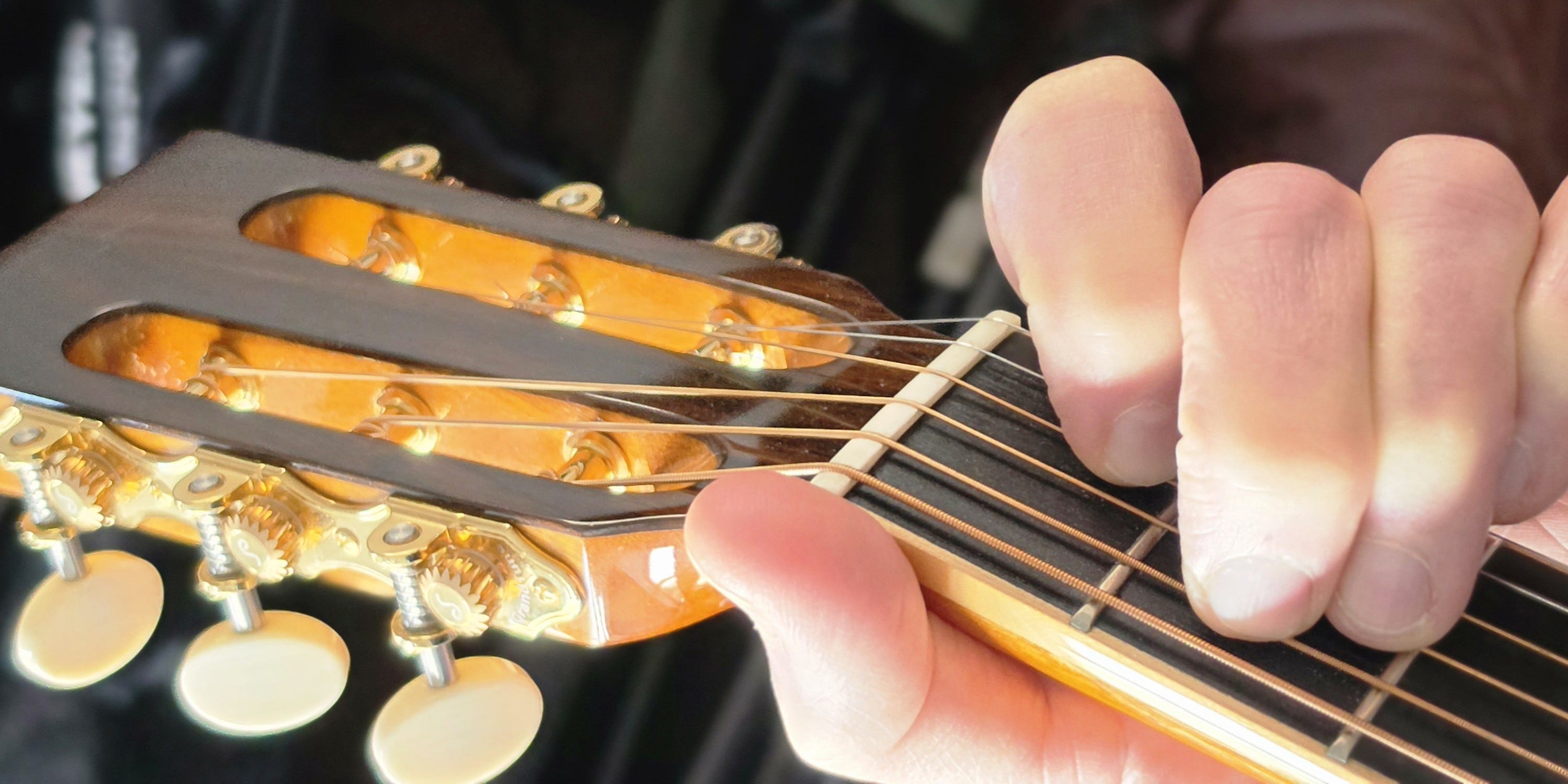
Now pick up your guitar. Play a few notes, remind yourself of that pattern of intervals we call the major scale (the Ionian mode). Then play an E on the sixth string. Just the single note. Let it ring. That’s the fundamental - the bare thread of melody our ancestors began with.
What’s happening when you pluck the string

But a plucked string never vibrates in just one way. It moves as a whole from end to end, and at the same time it also vibrates in halves, thirds, quarters and other fractions of its length. These fractional vibrations create partials - additional frequencies based on those fractions, stacked above the fundamental, that give a note its colour. On a well‑behaved instrument many of these partials fall into a harmonic series, simple ratios of the fundamental frequency that reinforce the pitch and enrich the sound.
Discovery experiment
Now play a full E chord in first position. Feel the difference. Feel what they were reaching for. That sense of reinforcement, of depth, of something larger than the single note. Play it again. Listen for the fifth (B) sitting above the fundamental, doubling part of its vibration and strengthening the octaves. Then listen for the major third (G♯) - the note that gives the chord its colour, its quality, its emotional tilt.
Look down at your fretted strings. Look at what you are actually playing: E, B, E, G♯, B, E. Three tonics, two fifths, and a major third - the 1st, 5th, and 3rd degrees of the major scale. Now confirm the feeling by playing those three notes on your E string alone:
open (E) (root, 1st degree)
4th fret (G♯) (3rd degree)
7th fret (B) (5th degree)
Now repeat them, briskly. What do you hear? It’s the three notes of the chord - the same intervals that appear in the early partials we’ve just talked about. Look at the pattern of frets: 0, 4, 7. That’s the pattern of multiple‑intervals that create a major chord.
What you’re hearing is the physics of the string made audible: the fundamental and its early partials, and the way other strings can reinforce or reshape them. This is the doorway into harmony. This is why the diatonic scale matters. And now we can describe, formally and clearly, how to make a chord.
How To Make A Chord
To build a chord, we start with a single note - the root, the 1st degree of the scale and the pitch the chord is built on. From that root we add the multiple-interval that gives the chord its stability: the perfect fifth. This isn’t an arbitrary choice; the fifth is the strongest partial after the octave when a string vibrates, so it feels inevitable to the ear. On some guitars your tuner may even detect it in the first moments of a plucked note. This root–fifth pair is the backbone of almost every chord you will ever play, and on the guitar it’s the basis of the modal “power chord.” Only then do we choose the colour. Once you learn the palette, that colour doesn’t have to be the obvious one - you have options that tilt the harmony in different ways - but for now, to turn this stable frame into a full major chord, we choose to add the major third above the root. That third gives the chord its emotional tilt, its quality. These three notes - root, perfect fifth, major third - are the 1st, 5th and 3rd degrees of the scale, and together they form the major triad.
Choosing The Colour
Before we look at the minor chord, it’s worth noticing that the third itself is optional. If we leave it out entirely, keeping only the root and the fifth, we get a modal chord - open, stable, and without emotional tilt. Guitarists know this sound instinctively; it’s the power chord, the frame without the colour. And instead of omitting the third, we can also replace it: swap it for the 2nd or the 4th degree and you get a suspended chord, a harmony that leans forward, waiting to resolve. These are all colour choices. The structure stays the same - root and fifth - but the lintel we place on top changes the mood.
And of course, the third isn’t the only way to colour a chord; adding other degrees - like the 7th - can shift its mood just as strongly, giving it tension, warmth or direction.
Pick up your guitar again and play that first‑position E major chord. Play it a few times until the sound settles into your bones. Now lift the first finger of your fretting hand and play it again. What happens? The mood shifts - not dramatically, but unmistakably. Describe it to yourself. Feel the way the harmony tilts. All you’ve done is adjust one pitch, the G♯, lowering it by one interval to G.
That simple adjustment teaches us two things. Colour is real - achievable with the smallest movement - and it’s yours to use. A single interval, changed by a single fret, can create a dramatic shift in mood.
Time for one more discovery experiment. Remember, we call the notes of the scale degrees, numbered in order of ascending pitch. Now that you know the 1st degree (the root) and the 5th degree are the supports of the chord, try adding different colours by choosing different degrees. Pick a major chord. Work out the root and the fifth, suspend the third, and then try adding the 2nd degree or the 4th degree. Play each version a few times and feel what happens in your bones. Each small adjustment shifts the mood - sometimes gently, sometimes dramatically - and all you’ve changed is a single degree.
Where We Go Next
Today we’ve explored the foundations of colour in harmony: how the 1st and 5th degrees give a chord its structure, and how the other degrees shape its mood. But colour is only half the story. Music also moves. Chords lean, pull, settle and travel, and that movement comes from the diatonic scale itself - from the way its seven degrees relate to one another. Now that we’re standing on the diatonic bank, the next step is to explore how harmony flows along it.
Some small definitions before we move on
Root
The root is the note a chord is built on - the 1st degree of the scale, the pitch that anchors the harmony. Change the root and you change the foundation; everything else sits on top of it.
Triad
A triad is a three‑note chord built by taking a degree of the scale and adding the notes a third and a fifth degree above it. The most common example is the major triad, formed from the 1st, 3rd and 5th degrees of the major scale. These three notes create the basic harmonic unit of Western music.
Stacked in thirds
Musicians sometimes say a triad is “stacked in thirds”. Don’t let the phrase worry you -it’s just a bit of jargon for a very simple idea: you take a note of the scale, skip the next degree, and take the one after it. Do that twice and you get the familiar 1–3–5 shape of a major triad. Nothing more mysterious than that.
Take Away
You’ve now reached the foundation stone of 21st‑century Western harmony: the simple frame built from the 1st and 5th degrees of the diatonic scale. These two degrees - the root and the perfect fifth - are the pillars of almost every chord you will ever play. Standing on the diatonic bank, you can see how every other degree you add is a colour choice. The classic example is the major triad, where adding the 3rd degree completes the chord and gives it its distinctive major colour. The structure stays the same; the mood comes from the degree you choose to place on top.
”The Story of Music” is a complicated one, but not difficult. Told weekly in this series, it keeps unfolding. To explore more you’re invited to join a conversation in The Story of Music reader’s room.