


Part 1 — The Plan
Why we’re even looking at this thing
Some guitars open up quickly.
Some take years.
And some - especially those with Adirondack spruce tops - can feel like they’re holding their breath for the first hundred hours of playing.
Éiru, my 000 12 Adi/Khaya, sits squarely in that category:
responsive, articulate, promising… but still a little tight-lipped.
So the question becomes:
Can we accelerate the break-in of an Adi top using mechanical vibration?
Or is this all just notional nonsense?
Evaluating the theory
The idea behind vibration conditioning is simple:
Wood fibres respond to repeated excitation
Resonant modes stabilise with use - the natural vibration patterns of the top become more consistent over time. (Resonant modes are simply the specific ways the soundboard flexes at different frequencies)
The top becomes more compliant
The guitar becomes more responsive
It’s the same principle behind “opening up” through playing -just delivered mechanically rather than musically.
The theory isn’t universally accepted, but it’s not fringe either.
Luthiers have used vibration fixtures for decades.
ToneRite built a business on it.
And players swear they hear changes.
So: worth testing.
But not worth believing without evidence.
The tools available
There’s a spectrum:
High-end luthier fixtures - expensive, industrial, not for home use
ToneRite-style devices - purpose-built, mid-priced, mixed reputation
DIY solutions - speakers, transducers, subwoofers; questionable stability
Generic vibration pucks - the “massage parlour” category
Which brings us to the Hanpun HK‑01.
The Hanpun (and its many OEM siblings)
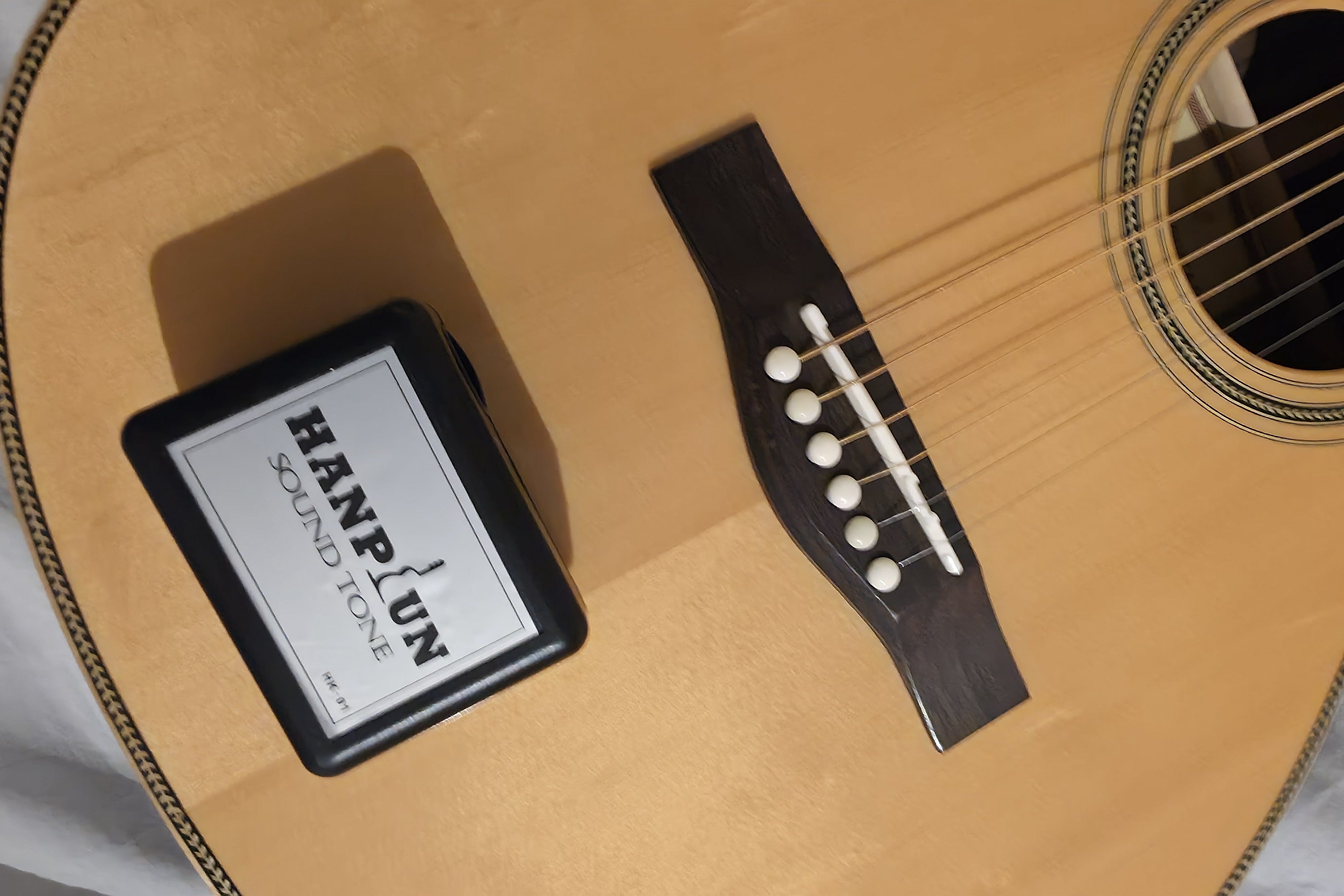
This thing is sold under a dozen names.
It’s a small, lithium battery-powered vibration puck with:
a simple motor
three rubber feet
a dial
a USB charging port
packaging that shows it wedged under guitar strings (don’t do that)
It’s not a ToneRite.
It’s not a luthier tool.
It’s a generic massage motor repurposed for guitars.
But it vibrates.
And vibration is the whole point.
So: let’s see what it can do.
How I’m going to test it
I’m not going to strum a chord and declare victory.
I’m going to use repeatable, semi-objective listening tests:
Low volume response - does the guitar “speak” instantly?
Chest feel resonance - how alive is the body?
Bloom test - does a single note swell or just decay?
Chord hang test - how long does a D chord hold together?
These are the same tests I used when Éiru was new, so I have a baseline. And I’m not going to play it, other than for testing - only the vibration from the Hanpun will count.
Introducing Éiru
Éiru is a 000 12-fret, Adirondack over Khaya, long scale, lightly built, and still early in her life.
She’s not a catalogue model. She’s one of those Sigma runs that quietly exist off-menu -part of a small batch (around 60 or so) produced by AMI for favoured retailers. There’s a “Munich” stamp in gold leaf inside the back, a small detail, but one that tends to signal a higher level of inspection and quality control.
The materials are well above what you’d normally expect at this tier:
single-piece Spanish cedar neck and headstock
ebony throughout - bridge, pins, fretboard, tuner buttons
bone nut and saddle
And the execution is at a level you’d normally associate with instruments far north of its price bracket.
She’s been played regularly and has seen light performance use in amplified settings, where clarity and control matter as much as raw projection. Even there, she shows promise: clean note separation, a quick attack, but a voice that feels like it’s not quite fully awake yet.
Under the hands, she’s responsive - but with that familiar Adirondack restraint. The headroom is there, the structure is there… but the openness isn’t fully realised.
Like a lot of Adirondack tops, she feels like she needs time, energy, and sustained vibration to really come into herself.
This project is about giving her that energy - deliberately, systematically - and seeing what happens.
The vibration programme
Here’s the plan:
Phase 1 — Wake Up (3 days)
Daily 100-minute vibration cycle:
50 min — lower bout bass
20 min — upper bout bass
20 min — upper bout treble
10 min — lower bout treble
Using a mass-loaded, face-down coupling method that keeps the HK‑01 stable and transfers energy efficiently. (Wait til you see the pics in part 2).
Phase 2 — Rest (8 days)
Éiru goes into her Crossrock fibreglass case at stable humidity and temperature.
Adi often improves during the rest period - I’m trusting the long-standing luthier’s intuition that vibration followed by rest allows the structure to “settle in”.
Phase 3 — Deep Conditioning (12 days)
Same 100-minute daily cycle.
Same rotation.
Same setup.
Listening tests at the start, midway and end of this phase.
Phase 4 — Final Rest (7 days)
Let the wood settle.
Then evaluate.
Part 2 — Coming in 30 Days
In the follow-up, I’ll answer the only question that matters:
Did the Hanpun HK‑01 actually change the sound of an Adi-topped guitar?
Can a €20 vibration puck do what 100 hours of playing does? Or was this all just notional nonsense?
We’ll find out.
Part of the MyGuitar - Gear Stories series
Explore more: go.gtr.ie/gear-stories