


I have these tuners on four of my acoustics, and I am about to buy a fifth for the guitar I take to the beach. They have earned their place through daily use rather than novelty. I reach for a guitar, tap the button, check the tuning, and I am ready to play.
First impressions
I wrote a short review on Amazon that still reflects how I feel. They are small, they stay hidden, and they never mark the wood. They are accurate too. I checked them against my Peterson strobe, and the readings were very close. The screen is simple, the response is quick, and the battery life seems steady. They are the kind of tool that disappears into the background because they do exactly what they should.
A small habit
After using them for a while, a few practical habits have settled in. The most reliable way to switch the tuner on is to use the thumb and index finger of my picking hand. I place my thumb on the D’Addario name so the tuner cannot shift or rotate. Then I press the ‘on’ button with the side of my index finger. The same movement switches it off. It is a small technique, but it works every time, and it feels natural on every guitar I have fitted with one.
Keeping myself honest
I still use my Peterson stroboscope. It is a way of checking myself as much as checking the tuner. When the NS Micro shows the note name with a blue line on each side, the tuning is usually spot on. It is reassuring to see that consistency across different instruments and string sets.
A steady pitch centre
The tuner also lets you adjust the reference pitch. I leave mine at 440 Hz because that is the standard for A4 and it keeps everything aligned with the way I play, teach and record. It is the same pitch I used in the octave post here on @myguitar, and the same pitch I use when checking with the Peterson. I like having that fixed point. It gives the whole instrument a sense of centre, and it helps the ear settle into the shape of the tuning.
One small quirk
There is one small quirk worth mentioning. When I pluck an open E, the tuner sometimes flickers and briefly shows a B. That is not a fault. It is the tuner catching a strong harmonic before the fundamental settles. The fifth of E is B, and on some guitars that harmonic can be very clear. Once the note stabilises, the tuner locks onto the correct pitch.
A closer look
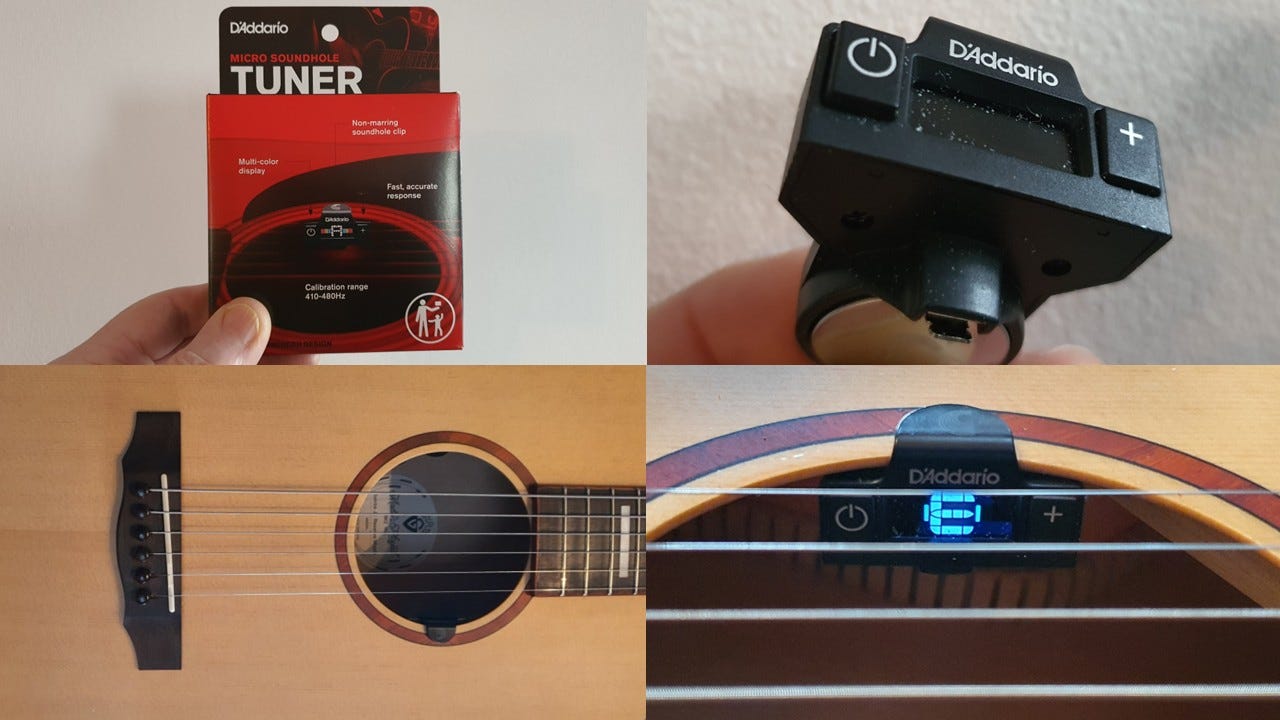
I’ve included a few photos to show how the tuner sits on the guitar. One of the box gives a sense of scale. A front view shows how discreet it is. A player’s eye view shows what you actually see when tuning. A final shot shows the size and simplicity of the unit. Together they tell the story of this useful little tuner.
This is a small piece of gear, but it has become part of my daily playing. It keeps the guitars ready, it stays out of the way, and it earns trust through accuracy rather than features.