

<Story index
How many times have you been to the cinema, or turned on the TV, and watched a great novel ruined in the telling. That’s the story of musical modes. A great story, ruined in the telling.
So let’s start again - not with diagrams or labels or rules - but with what you already know. - With sound. With the way music feels. Because it's likely that you already sense the differences I’m going to describe.
Let’s start with something familiar. Something that’s probably deep in your bones:
“do, re, mi, fa, so, la, ti, do.”
You can sing it to yourself if you like. Feel the way it rises in steps. Feel the long and short steps in your own voice - steps you’ve been using your whole life without ever noticing they were there.
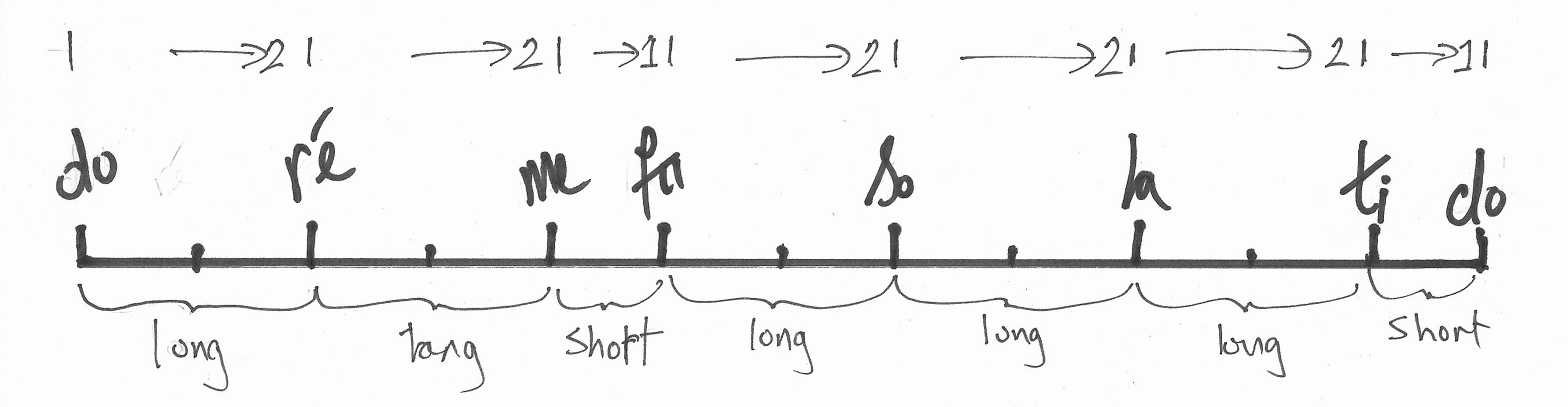
Let’s pick up a guitar and noodle for a moment. Play the major scale slowly, notice the way it moves through long and short steps until it brings the sound home. It’s a shape your ear already knows. It’s that “do ré me…” the sound of “home base” - the place melodies like to return to.
That shape, that pattern of steps has a name: Ionian - but the name isn’t the point.
The point is the pattern: the mix of long and short steps that gives the scale its familiar movement.
But let’s stay in our childhood, let’s play a skipping game. Imagine the chromatic scale as twelve stepping-stones laid across a river. Now in this game you can only skip on seven of them. But that’s not the fun part, - it’s the pattern of steps you choose that’s fun. You have to pick a pattern of steps that tells us how you’re feeling as you cross: curious, bold, cautious, wistful.
You’ve already given us one, with that “do ré me…” But you’re a bright child so you’ll quickly recognize that there are lots of possiblities for different patterns of skipping on those stones to cross the river. Lots of different ways to express mood and feelings
But it's time to come back to today and move on from talking about “steps” and “slices”. They've been helpful words, but now we need something more precise, and musically exact. One we can use as a solid foundation for our way forward - Interval.
Interval
The distance you feel when you move from one fret to the next. - Making it the smallest possible distance between two adjacent pitches in our 12 step - now 12 interval - chromatic scale
This is a tighter definition than you’ll find in most music books. Many teachers use interval to describe any distance between two notes, large or small. When I need to talk about those larger distances, I’ll call them multiple‑intervals.
Here, interval means the smallest step - the basic unit of musical distance. Sometimes the next pitch in your scale is one interval away; sometimes it’s two or more. Using the word this way lets us talk about intervals and frets almost interchangeably, and it gives us a precise, physical way to describe the space between pitches.
When the Pattern Breaks
Now we have a way of describing the physical space between the notes. Let's think again of the major scale. Not the idea of it. Not the theory of it. Just the feel of it - the feel that arrangement of intervals gives us.
And when you noodle with it - sliding into notes, lingering on some, skipping others -you’re not thinking about theory or rules. You’re that child just following the motion of the pattern of stepping stones across the river.
That motion is what gives the scale its feeling. It’s why it sounds settled, open, and clear. And here’s something you’ve probably felt without ever naming it: If you step onto a note outside that pattern - one of the stepping stones you are not supposed to be using- the whole thing jolts. It’s like putting your foot on a loose stone. Your ear flinches. You feel the pattern break. And that tiny jolt tells you something important:
The pattern is real. Your ear knows it. And it knows when you leave it.
The scale is the sequence of seven notes you play.
The mode is the pattern underneath it.
The major scale is a mode, and long before anyone named it, people were already at home singing and playing with these steps. But it is only one mode - the Ionian mode - and the others weren’t built from it. They were its siblings, patterns people were already singing long before anyone tried to force them into a single family tree. The 19th‑century teaching shortcut that treats the modes as “children” of Ionian is convenient, but it hides their real identity - and if you doubt that matters, try walking into an Irish trad session with only the modern rotation model in your head.
To talk about these modes clearly, we need one more piece of language.
We’ve already discovered that the word interval lets us talk clearly about walking up and down the chromatic scale - almost the same as talking about frets. Now we need the matching word for those stepping‑stones we’ve been skipping on. When musicians talk about those stones - the places your ear expects you to land - we call them degrees.
Degree
The position of a note within a scale, counted upward from the starting note.
If you imagine the scale as the line of seven stepping stones you can skip on, the degrees are simply the stones themselves - first, second, third, and so on. Each degree has its own character and its own role in the pattern, and using the word degree lets us talk clearly about how melodies move. But if these degrees are so significant, where did they come from?
Before There Were Patterns, There Was the Voice
Imagine stepping back to a time before scales, before degrees, before notation, before the twelve equal interval steps were carved into the landscape. All you have is a voice. You breathe in and the sound rises. You breathe out and it falls. You hover on a note because it feels right. You slide away from another because it doesn’t. You repeat a pattern because something in it matches what you’re trying to express.
There are no rules here. No right notes or wrong notes. Just instinct. A rise in pitch that feels hopeful. A fall in pitch that feels tired. A small step that feels cautious. A bigger one that feels bold. You’re not following a pattern - you’re discovering one.
Not by thinking, but by singing, by playing.
And everyone around you is doing the same. A whole community of voices gradually settles into shared habits:
certain rises that feel like beginnings
certain falls that feel like returns
certain turns that feel like questions
certain landings that feel like home
These habits become familiar. They become the musical accent of a culture. These were the first modes - not as theory, but as ways of moving through sound, through pitch, that people kept returning to because they felt true, they sounded right.
The Modes Hiding in Today’s Music
Before we name anything, let’s stay with the sound of things.
The gentle‑rise pattern
Think of Scarborough Fair, or The Star of Munster, or any melody that feels dreamy or wandering. Early in the tune there’s a particular rise - a big step up, then a smaller one - that gives the melody a kind of gentle lift, as if it’s looking out over a landscape It’s not happy or sad. It’s curiosity mixed with longing. And you’ve just remembered one of the old patterns.
The forward‑push pattern
Now think of Norwegian Wood, Sweet Home Alabama, Royals, or a traditional reel. These tunes have a different kind of movement - two steady steps forward, then a quick one - that makes the melody feel grounded and energetic, like it’s leaning into the next beat. It’s the feeling of momentum. And You’ve just heard another old pattern.
Two patterns - Two feelings. And so far, no theory needed.
Now We Reveal the Patterns
Underneath those feelings are simple patterns made by moving through steps of one and two intervals or frets.
So the do ré me pattern was
0-2‑2‑1‑2‑2‑2‑1
A pattern sounding settled, open and clear
The gentle‑rise pattern:
0-2‑1‑2‑2‑2‑1‑2
This is the pattern that creates that open, searching lift.
The forward‑push pattern:
0-2‑2‑1‑2‑2‑1‑2
This is the pattern that creates that rolling momentum.
Only after people noticed these patterns did they give them names:
Ionian → 0-2‑2‑1‑2‑2‑2‑1
Dorian → 0-2‑1‑2‑2‑2‑1‑2
Mixolydian → 0-2‑2‑1‑2‑2‑1‑2
But the names came after the music. The patterns came first; they were already alive in the tunes. We only recognised them formally when we laid those traditional patterns of short and long steps over the evenly spaced twelve intervals of the chromatic scale. That’s when the modern names were confirmed.
What People Actually Called These Sounds (c. 1695)
By the late 1600s, musicians had been singing and playing these shapes for centuries.
Nobody talked about “modes” the way we do now. They didn’t think in labels. They thought in feelings. They recognised sound‑types, not categories:
“the old minor” (Dorian)
“the major with the flat seventh” (Mixolydian)
“the straight major” (Ionian)
“the sad minor” (Aeolian)
Folk musicians often used tune families instead of theory:
“It goes like Greensleeves.”
“It’s in the Lilli Burlero way.”
“It’s the same pattern as John Barleycorn.”
Modes weren’t systems. They were expressive habits - patterns that gave a progression of pitches people liked.
Some Modes Survived, Others Didn’t.
Across European traditions, some interval patterns became everyday favourites and others fell away. Dorian and Mixolydian endured because they sit comfortably in the voice.
Dorian: Sadder than Ionian, but not as sad as Aeolian - the scale we today call the natural minor. In Dorian, the 6th degree has a pitch one interval higher than in Aeolian. That “raised” 6th prevents the heavier sadness we associate with the natural minor pattern. It keeps the sound open, even when the melody leans toward melancholy.
Mixolydian: Ionian in flavour, but with the 7th degree one interval lower. It’s the same difference guitarists hear between a major‑7th chord and a dominant‑7th chord - that slight drop in the top pitch that changes the whole emotional shape. In a scale, the lowered 7th gives Mixolydian a relaxed, open quality that suits unaccompanied singing beautifully.
Phrygian and Locrian faded because they feel unstable. Phrygian begins with a one‑step interval (1 – 2 – 2 – 2 – 1 – 2 – 2), which gives it that tight, tense opening. Blues players will recognise the feeling - that deep, diesel‑engine growl in the stomach. It’s exotic, edgy, and hard to pitch cleanly against a drone.
Locrian goes further. Its 5th degree is “flattened” by one interval, so the ear never gets the stable “home” that almost all Western melodies rely on. Without that solid fifth, the whole mode feels like it’s leaning sideways. If you want to hear this instability, take your guitar and, starting on your open A string, fret this pattern:
1 – 2 – 2 – 1 – 2 – 2 – 2
That’s Locrian - and you’ll feel immediately why melodies don’t settle there.
The point here is that folk music is melody‑driven, and melodies in Dorian and Mixolydian sit comfortably over drones. Phrygian and Locrian don’t - they push against the drone, offering notes that clash with the fixed pitch of the drone underneath.
Laying the Patterns Over the Chromatic Scale
Now that you’ve heard these patterns in real music, we can place them onto something solid: the twelve‑interval octave (the chromatic scale). Return to that imaginary river crossing — twelve evenly spaced stones, all the same size. When you move across those stones using different combinations of one‑interval and two‑interval jumps, you create different patterns, different modes.
The chromatic scale is the path.
A mode is the pattern you walk along it.
Same twelve intervals. Different patterns. Different feelings.
Finally, in case you’re curious, the mode names themselves come from the peoples and regions of Ancient Greece, even though the interval patterns they name are entirely modern.
If you want to explore these patterns for yourself, you can download a simple PDF I’ve created. It lays out the twelve‑step chromatic scale and the interval patterns for each of the seven surviving modes from the ecclesiastical and 17th‑century tradition and hints at their use in modern musics.
Download it here: https://dm.ie/modes
Take-Away
Modes are seven pitches, in patterns chosen from the twelve notes of the chromatic scale. Each pattern creates a different kind of movement and a different emotional colour.
Ionian and Aeolian are the best‑known modes - the major and minor scales we all grow up with.
Dorian is central to Irish traditional music, giving many airs and ballads their open, bittersweet sound.
Mixolydian and Dorian appear naturally in pop, folk, and film music because their patterns feel intuitive and expressive.
Some modes survived because they work with drones and melodic habits.
Dorian and Mixolydian blend well with the fixed pitches of pipes, fiddles, banjos, and early folk instruments.Other modes faded because they clash with drones or lack stable anchor points.
Phrygian begins with tension; Locrian weakens the fifth — the note melodies rely on for stability.
Of course, not every real‑world pattern fits neatly inside these modes. Music is full of shapes that live beyond the tidy rules we’ve just mapped. The pattern we use for expressing the blues is a classic example - a lived, expressive sound that sits outside the tidy interval patterns we’ve just explored
In the end, modes aren’t theory - they’re expressive patterns.
Different ways of selecting seven notes to shape how a melody feels.
”The Story of Music” is a complicated one. Told weekly in this series, it keeps unfolding. To explore more you’re invited to join a conversation in The Story of Music reader’s room.